

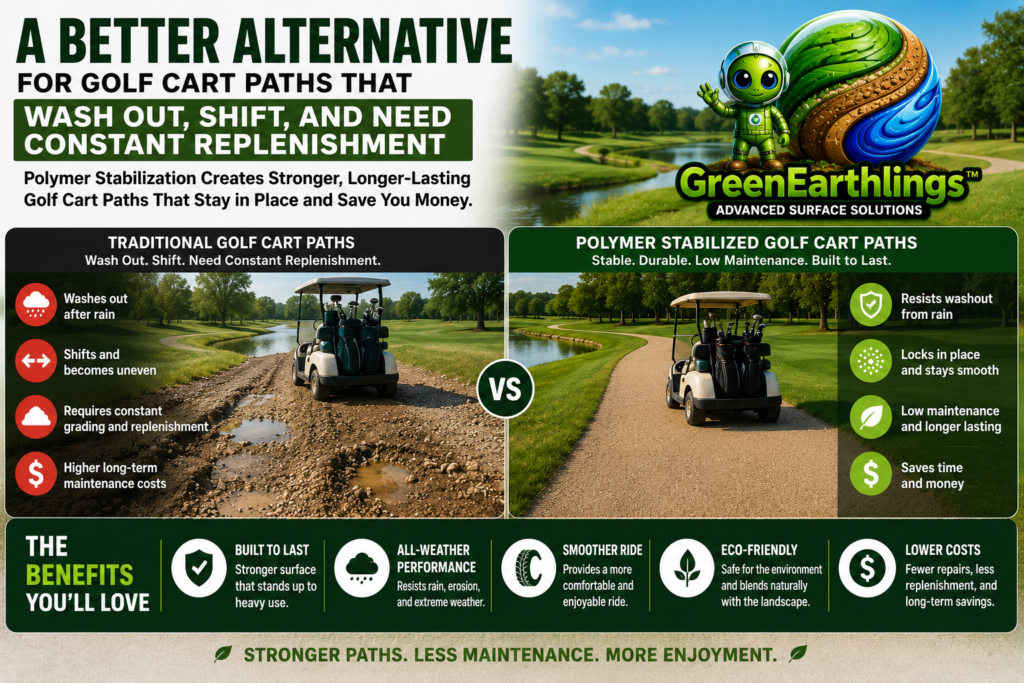
Why golf cart paths become a maintenance problem
Golf cart paths often start out looking beautiful. The trouble comes later. Rain moves the material. Tires shift it. Edges break down. Fine granite and sand migrate. Crews end up bringing more aggregate back in, regrading sections, raking surfaces, and trying to keep the route looking clean and usable.
Even routine maintenance can make the problem worse. When leaves, debris, or clippings are blown off a loose cart path, some of the path material goes with them. Over time, the course loses both labor and aggregate. What should be a polished natural feature becomes a recurring maintenance issue.
Why loose granite paths can be frustrating
Many golf courses prefer the natural look of granite or other fine aggregate paths for a good reason. They fit the landscape. They look softer than concrete. They feel more appropriate for the course. The problem is that loose material rarely stays perfect under traffic and weather.
Once erosion starts, the path can lose shape and finish quickly. High traffic areas become rough. Slopes become vulnerable. Water carries fines away. Regular replenishment turns into part of the maintenance routine. That ongoing cycle costs money, takes staff time, and often leaves the course chasing the same problem areas again and again.
A better way to build a natural looking hard surface
There is another approach. A properly designed polymer stabilized cart path can create a hard, compacted surface while still preserving the natural look many courses want. Instead of depending on loose material to stay in place by luck alone, the path is built as a more cohesive section designed to resist movement, washout, and repeated surface loss.
In general terms, the process starts with loosening and preparing the path. The section is reshaped as needed. Aggregate is added or adjusted based on the route, the slope, and the finish desired. A polymer solution is applied, blended through the surface layer, and compacted. In some systems, an additional application helps tighten the finish and create an even cleaner top surface. When the blend, moisture, and compaction are handled properly, the result can be a natural looking hard path that performs far better than loose aggregate alone.
Why this matters on a golf course
Golf courses do not just need a path that survives. They need a path that looks like it belongs on the course. That is why this category is so attractive. It gives clubs a chance to reduce erosion and maintenance without forcing every route into a broad concrete or asphalt look.
For higher end courses in particular, that balance matters. A stabilized fine aggregate path can preserve the visual character of the property while giving the maintenance team a much stronger and more reliable surface to work with.
Better maintenance and less material loss
The maintenance benefit is one of the biggest reasons golf properties should pay attention to this approach. A better cart path can mean less loose material migrating into turf and bunkers, fewer washouts after rain, fewer soft sections, and less frequent replenishment. It can also reduce how much path material gets blown away during routine cleanup.
Instead of constantly trying to restore the same sections, the course can move toward a surface that stays intact, looks cleaner, and performs more consistently over time. That is not just a visual improvement. It is a meaningful maintenance improvement.
A strong fit for more than cart paths
This approach can also make sense for walking paths, maintenance routes, service access areas, and other golf course surfaces that need to remain attractive while holding up under repeated use. The right aggregate profile can be selected based on the route, the traffic, the slope, and the look the course wants to maintain.
That flexibility is important because not every route on a golf property should be built the same way. Some sections need a more refined finish. Others need more structural strength. The smartest solution comes from evaluating the actual use of the path and building the section accordingly.
Where Green Earthlings fits in
Green Earthlings helps golf properties evaluate these options in a practical way. That includes reviewing the condition of existing paths, discussing aggregate choices, comparing surface approaches, and helping connect courses with qualified providers who understand how to deliver natural looking hard paths that perform the way a course needs them to perform.
If your golf property is dealing with washouts, repeated granite replacement, dusty paths, or constant grading and raking, Green Earthlings can help you understand what alternatives are available and what type of stabilized surface may be the right fit.